
The new rhinos...a testament to the strength, stamina and resilience of White Rhino
Updated: 12 hours ago

It's been a WILD first few weeks for these two new rhinos and our entire CRCI team!
For many months, we considered ways to make the next two community rhinos' translocation trip (moving them from Malilangwe in the South-eastern part of Zimbabwe to their home in Sanctuary 2a on communal lands adjacent to Hwange National Park's southern boundary) as smooth as possible...a huge challenge considering the very poor state of some of our roads. We considered trains, the Elephant Express with a trailer, planes...and in the end, we opted for another road trip. With a lot of extra preparation the trip went off without a hitch and when the two new rhinos finally reached their new home safely, everyone sighed with relief.
Find out more about this and see a video run-through of the trip here
A translocation is much more than just the moving of an animal from one place to another. A long distance translocation such as this requires a great amount of planning and preparation to ensure success with least possible stress; losing a rhino in transit is not an option. But once they’ve arrived, it’s all about the subsequent "settling down phase" as they become acclimated to their new home, bearing in mind that white rhinos are well known for being highly strung and easily upset. And it was this "settling down phase" that was anything but settling with our two newest rhinos!
Rhino management can be unpredictable and so to be successful, it requires plenty of ‘hands-on’. Successful rhino conservation projects require resources of an “eye watering” scale, the input of experienced experts and many different stakeholders (especially given the fact that we are community-based), and last but not least, unwavering dedication. We are very fortunate to have had an excellent team around us who have supported us open-handedly throughout the last few weeks, from the Malilangwe and Victoria Falls Wildlife Trusts as well as our Parks and Wildlife Management Authority, to mention only a few. Now, 7 weeks after their first arrival, we can finally say with confidence, the rhinos are finally settling in.
A white rhino like no other...retracing 905's footsteps over the last 7 weeks:

28th July: The initial capture and translocation
On the 28th of July we were first introduced to rhinos 905 and 91 by the team at the Malilangwe Trust. They had been chosen by the ecologists at Malilangwe according to their tried and tested criteria i.e. maternally they are not related, they are mature but still young and, most importantly, they are best friends. The two rhinos were darted, tranquilised and then loaded into specially designed white rhino crates and put onto an impressive 6x6 crane truck, ready for a long 18-hour drive to the CRCI’s Sanctuary 2a.
Rhino 905 was the first one darted by the vet from the helicopter; he’s the younger of the two and indeed after his capture, the whole exercise was described as “ … easy peasy … smooth as silk.” The memory of those comments 7 weeks later makes us smile.
We had both rhinos loaded and the truck and its convoy departed from Malilangwe early afternoon on the 28th of July for that long drive across Zimbabwe.
Interestingly, it may have been one of the elements in the cocktail of drugs administered to keep 905 “relaxed and chilled” that may have led to the roller coaster of events that would then unfold.
29th July: The rhinos arrive and are released
The arrival of the two rhinos at Sanctuary 2a was both exciting and challenging. Fresh from the wild, they were understandably nervous, highly alert and determined to test their new surroundings. They were released in the Sanctuary 2a habituation boma, an enclosure about 3-hectares in size with a stout electrified fence as well as black woven fabric sheeting providing a solid visual barrier. At first, all went well (see recap here ).
Rhinos caught directly from the wild can be particularly sensitive to unnatural noise and movement. Human voices, vehicles and any small disturbances can cause them to turn rapidly, become defensive or challenge the electric fence. So it was essential to keep things as quiet as possible and give the rhinos time to settle, make them feel undisturbed and safe. They seemed to be staying close together and spent considerable time investigating the boundaries of their new enclosure, or boma.
Within the first 48 hours, the sedatives from the translocation trip had worn off and right from the beginning, rhino 905 seemed unusually intense and feisty, especially compared to the first 2 pairs of bulls we’d successfully translocated – the beloved Thuza and Kusasa...Even a drongo bird flying by would spook him.
2nd August: The great escape
Despite the rhinos challenging the electric fence, and minor repairs being needed, all seemed to be going to plan ... until the early hours of August 2nd.
During the night, both rhinos were challenging the fence but 905 was particularly persistent. Fence wires were broken, black woven fabric was damaged and torn, and repairs became increasingly difficult because the animals became agitated whenever our Cobra scouts approached to carry out repairs. It was during this night that 905, later referred to by our scouts as “the Wizard”, learnt he could break electric wires using his ‘insulated’ horn.
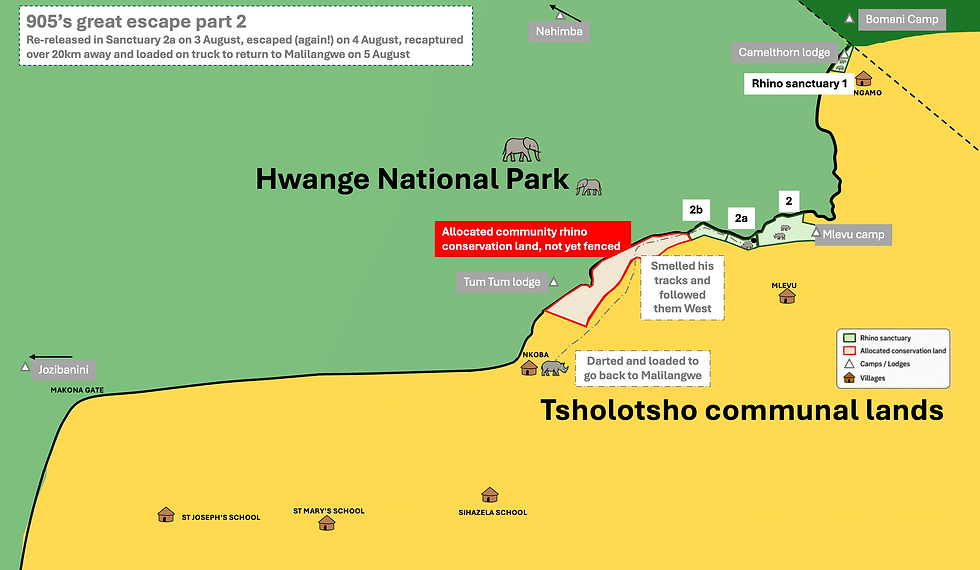
In the early hours, 905 initially broke out of his boma into the larger fenced sanctuary area. But at 8am, he broke through a gated corner of that sanctuary and escaped into the surrounding communal lands heading westwards. That was when he learnt a second lesson: sanctuary gates can be a ’weak point’.
What followed was a challenging follow-up operation, and a very big test of our Cobra scouts’ training and skills. Looking back we’re proud to say they were not found wanting. A running rhino can cover a lot of ground, they can achieve 40 mph in a charge and their stamina is legendary.
Our Security Manager, Dan recounts:
“Our prevailing wind is from the East, so because he was moving down wind, great care was needed to prevent continuously pushing him further West. Our Cobra scouts tracked him on foot, ‘dog legging’ because of the wind and ‘leap frogging’ using a vehicle, but they slowly closed the gap. He followed the National Park boundary for several kilometers. Along the way and was spooked by villagers collecting firewood in their scotch carts which forced him to change directions.”
By that evening rhino 905 was still on the run; he had not yet found water, was probably tired and had slowed down. We had arranged a spotter plane, which arrived late afternoon to assist us, and while in communication with our Cobra scout team on the ground, they located 905 resting in a thicket several kilometers north west of Sihazela school. While this was going on our experienced vets, a 4x4 crane truck with rhino crates, a Malilangwe capture team, a helicopter and local Parks personnel were all converging on his location. The stage was being set for the following day’s rhino capture.
Meanwhile, amidst all the drama and anxiety, rhino 91 remained inside his boma at Sanctuary 2a. He too had learnt a lot the night before so continued testing the fence and so the Cobra team there had their hands full too making sure the fencing was repaired as quickly as possible. Without the electrics working, rhino 91 might also break out and we’d have two rhinos running loose!
On Monday 3rd of August, Cobra scouts were back on 905’s tracks before dawn. They reported 905’s tracks moving steadily ever westward, so back up teams were leapfrogged ahead to try and cut fresher tracks and close the gap created overnight. But imagine our surprise when a third team of scouts in a vehicle reported from a ‘leap frog’ way ahead that they’d found fresh tracks returning from the West headed eastwards; they immediately deployed on foot, the spotter plane was called and got airborne and a plan was hatched for all the teams to converge on St Mary’s School, with its convenient soccer pitch soon to be a helicopter landing zone.
Soon after arriving overhead our spotter plane located our Cobra scout team on 905’s fresh tracks and then moving ahead of them, the plane found 905 ambling up an elephant path leading to a natural waterhole, where he was able to slake his thirst. This was good news. The Cobra team was called off to avoid scaring him with their smell but the plane maintained an epic tight orbit high overhead with eyes on 905 for the next 6 hours in heated turbulent conditions. Eventually the spotter plane was relieved by the helicopter, whilst the teams on the ground cut a road 7 kilometers from St Mary’s School towards where 905 was resting in a shady thicket.
During this time our Parks personnel arrived and reported they had seen his tracks from the previous night even further to the west at Makona gate and then a passing bus driver reported to us as having seen a rhino in his headlights in the early hours of the morning, even further west of Makona at Gwabazabuya near St Joseph’s school. The driver told us he had hooted at the rhino and thankfully 905 turned and fled eastwards, hence the eastward tracks discovered by the Cobra scout team earlier that day. This was a very fortunate turn of events…without the bus driver hooting and spooking him, 905’s next stop westwards could have been Botswana!
Only by 4pm of that long day was our vehicle and truck team positioned close enough for it to be possible for 905 to be successfully darted from the helicopter, tranquilised, blindfolded and roped, then partially reawakened and walked into his waiting crate. Then followed another very long drive back to Sanctuary 2a for him and our exhausted teams. Back at Sanctuary 2a boma, all the broken electrics and sheeting had been repaired, patched up, pinned down and strengthened. We offloaded 905 back into the boma, woke him up and sent him to join his buddy 91. We crossed fingers and held our breath.


4th August: …he’s done it again!
Then on the 4th August, he escaped again. He broke out of his holding boma leaving his colleague 91 and headed into the larger Sanctuary 2a. We monitored him and watched as he tested the Sanctuary fence a few times, but the electrics deterred him. Anxious we hoped that maybe just getting into a larger space away from human smell and noise might help him to settle; we moved water using our water bowser to a pan for him and at sunset we knocked-off with all fingers and toes crossed, but apprehensive and fearing the worst.
Imvelo’s Managing Director Butch recounts the inevitable happening…:
“Just after dinner at Camelthorn Lodge with our veterinary team, radios began squawking, we cringed as our worst fears were realized – 905 had broken out and was on the run again, ever westwards. One Cobra team followed him in the dark and another second team was quickly assembled and dashed to try and get ahead and block him en-route as he was heading steadily towards the western end of the neighbouring Sanctuary 2b. Only one fence now remained between him and the bizarre assignation he appeared to have in the West. As the second team arrived, 905 too had just arrived at that fence and in the headlights we could see he was trying to break out. We banged car doors, turned him and quickly set up a chain of fires along that section of fence to deter him. A long night followed keeping fires burning, patrolling and watching whilst 905 marched up and down trying to figure out how to overcome the latest obstacle we had thrown in his path. At dawn, of course, he figured it out, moved north to go around the blocking party, used his horn to disable the electrics and amassed his strength to smash the fence, which he promptly did at a gallop. Once again, we were on tracks at dawn, but now with no spotter plane (it had returned to Harare being low on fuel) and a chopper with very limited fuel.”

One Cobra team tracked 905 on foot and two teams with vehicles leapfrogged ahead, looking for fresher tracks and then taking over as they found them. After about 20 km, he came adjacent to Ndodana village and slowed down, his westward trajectory blocked by a village with people and noise.
The helicopter and darting team got ready and the crane truck and rhino crate were moved into position nearby. He had stopped in an extremely remote and difficult patch of scrub bush.
Butch recalls:
“905 was a long way from a road so with what little fuel the chopper had, it skilfully and slowly herded him closer to the road that runs between Ndodana and Nkoba villages (Tum Tum guests will know it from The Schoolbus Run!). As he drew close to the road, he was darted with tranquiliser. But in true 905 fashion, he continued to doggedly fight the drugs and managed to cross the road into still more thick bush, before going down.”
Villagers led by their local village headman from Ndodana came streaming in to help open a road, and for the 3rd time in a little over a week, we loaded 905 into the rhino crate and onto the truck. Plenty of deliberations led to a consensus amongst our team that we were dealing with an impossible individual and it would be best to return 905 to Malilangwe, his familiar habitat, and perhaps also return his buddy 91 as well.
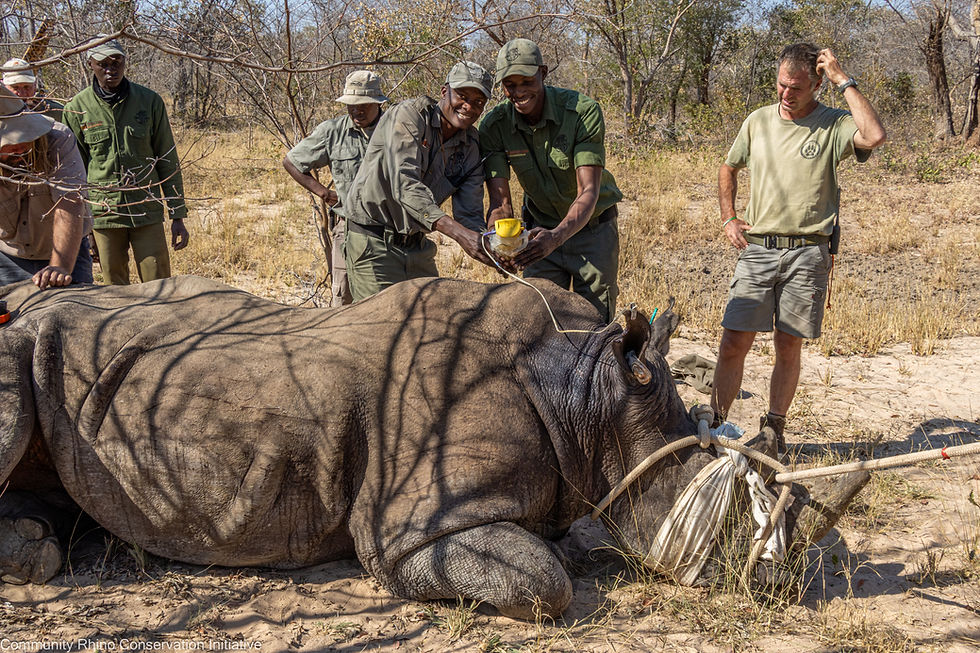

5th August: Returning to Malilangwe
Despite this tough decision was made, it seemed like 905, once again, had other plans.
Butch explains:
“Exhausted and broken-hearted we started the drive. After only about 50 km, as we drew level with Kapane school, our worries sky-rocketed. It’s really important on these long drives that rhino stand up periodically to ensure circulation in their limbs and as 905 was struggling to stand up, we began to seriously doubt he could make the 18 hour drive back to Malilangwe without serious complications. What to do?”
And this is where the combined experience and smarts in our team paid off. Sanctuary 1, about 40 minutes away, is ringfenced with 4 strands of 6-tonne cable as well as electric fencing. So far 905 had been breaking electrified wire fences but 6-tonne cable had deterred him.
“ … So, what about putting Thuza and Kusasa our two Sanctuary 1 rhinos into their 2-hectare holding boma and then releasing 905 into their larger 180-hectare sanctuary to try to let him recover there?
A quick radio call and turn around for the convoy and we drove for Ngamo Sanctuary 1, worried and anxious. Fifteen minutes out, the Cobra scout team had managed to get Thuza and Kusasa into their boma; that was step 1 done. After arriving at Sanctuary 1 through Gate 2 just after dark, we offloaded 905’s crate, and we elected to open his crates’ front door so he could maybe (if we were lucky) drag himself out. We gave him a 100% reversal drug and waited … very worried.
Usually, it takes 4 minutes for the reversal drug to take full effect, but after only 3 minutes 905 snorted twice, stood up and walked out … like he owned the joint. We were pretty sure the cable fence would hold him, but as a precaution, we parked vehicles in front of our gates to act as an extra deterrent as we knew gates were firmly on his radar.”
That night he hit the 4 strand 6-tonne cable fence hard, twice, but failed to move it. He also checked out the gates but left them, and the next morning we breathed a huge sigh of relief. Thuza and Kusasa who had kindly, albeit involuntarily, vacated their territory and were languishing in their boma, were rewarded with a bale of lucerne each. It appeared our plan might work, but the situation was far from resolved.
August 5th to mid-August: Settling in
Despite his cuts and scrapes, 905 finally seemed to be relaxing a little bit. We monitored him cautiously from afar and were delighted to see that with his great resilience this incredible animal began feeding well, found the waterhole and appeared to settle into a routine none the worse for his ordeal. Back at Sanctuary 2a, 91 also appeared to be settling a little and challenging his fence less, although still restless without his friend 905.
So we made another big decision, to change the plan of returning them to Malilangwe and instead ring fence Sanctuary 2a boma with cable, move 905 back there once that was done and deploy ‘magic fingers’ (live electric wires that protect a fence from elephants that have learnt their tusks don’t conduct electricity) and perhaps we can teach 905 to respect electric fences, cure him of his fence breaking habit, reunite him with his best friend 91 and habituate them both together again in their new home. All of our team, reluctant to accept failure, jumped at the idea.
Boma upgrades underway at Sanctuary 2a, under the watchful eye of rhino 91.
At Sanctuary 2a, the next 10 days were a frantic flurry of cable fence upgrading and gate construction. But at Sanctuary 1, 905 was steadily getting his strength and attitude back. Becoming more sure of himself, he patrolled the Sanctuary 1 mainly at night. Thuza and Kusasa seemed more and more irritated by their confinement and one night got into a fight, with the noises attracting 905. The Cobra Scouts guarding Thuza and Kusasa tried to head him off but instead they were chased up trees, chaos loomed.
18th August: time for another road trip
Then on the night of the 18th, things came to a head. 905 attacked two of our vehicles blocking gates. Though the vehicles were damaged, thankfully the gates held. And it became increasingly obvious, he could not stay in Sanctuary 1.
The strengthening and cable work at Sanctuary 2a boma was completed and ‘magic fingers’ (electric wires) installed and hot. The enclosure was partitioned in two areas so that the rhinos could be reunited close to each other, but still have their own space to avoid any fighting. Everything was ready. We knew it was now time to return 905 to Sanctuary 2a.

19th August: Reuniting the boys
On the 19th of August, our combined CRCI / Malilangwe / Vic Falls Wildlife Trust / National Parks / Imvelo team was regathered as well as another crane truck. 905 was located late afternoon by our Cobra scouts in the woodland just north of Camelthorn Lodge, where he was again darted, successfully sedated, ‘walked’ to the road and reloaded into his crate, which was then loaded onto the truck and then transported back to rejoin his colleague 91 at Sanctuary 2a. The trip to Sanctuary 2a was again fraught with issues and took nearly 5 hours; the crane truck we used this time didn’t handle the sand well and we had to tow it most of the way with a 4x4 tractor, which was slow. At about 8.30pm we parked the truck next to the boma 2, while rhino 91 was in the adjoining Boma 1. We used the crane to hoist him and his crate off the truck and into the boma, reversal drugs were administered and we opened the crate door at about 9 pm.
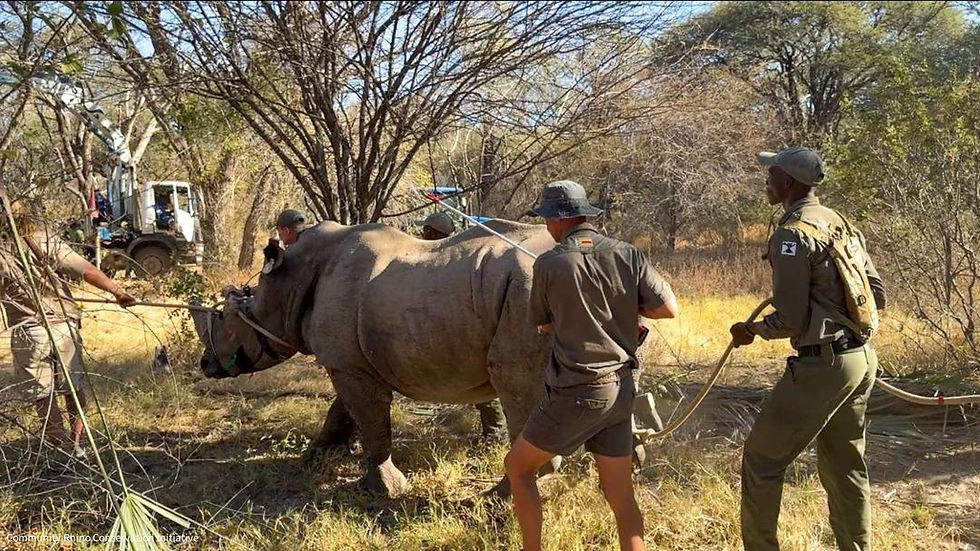

Butch describes the tense moment:
“Three mins later, in the eerie moonlight, 905 walked out, looked around and marched off into the darkness. Then, terrifyingly, 5 minutes later we heard him in a full gallop in the south west corner of his boma and hearts in our mouths (again), we heard him hit the fence at full charge, a huge crash and then silence, then a few moments later we heard him walking back but still inside his boma … the cable fence had held. It was only the next morning we realised how close he had come to breaking out, again: several large steel crosby clamps holding the 6-tonne cables had stripped and a couple of strands of the guitar string tight cable were hanging limply. If he’d hit the same spot a second time he might have got out … but he didn’t, so our plan had worked.
We listened and decided best to leave him to hopefully settle down, later back at Camelthorn another late dinner and the radios squawked again, but this time only to report 905 had broken out of his Boma 2 and had gone into Boma 1 through an uncabled partition and rejoined 91…and there was no fighting. Huge sighs of relief. The best friends were together again, maybe now there’d be some quiet.
The next morning we were there early, our joy was huge, because there the two of them were enjoying the early morning suns warmth, lying shoulder to shoulder… however we kept our fingers crossed.”

22nd to 26th August: finally some progress
By the 22nd of August, the two rhinos were showing encouraging signs of settling. A small fight between them was quickly over, and preparations began to formally open the gate between their two sections to give them extra space.
On the 23rd of August, 905 successfully went through the gate into the second enclosure and they have since then understood that they can move freely between the two areas, giving them improved access to space, water and food.
There has still been some fence testing, with the rhinos still getting zapped by the electrics. But these are becoming less and less frequent. Within a few more days, both were feeding more frequently and were stuck to each other like glue, reminding us greatly of Thuza and Kusasa.
Today
Three weeks later, they are feeding well, moving freely between Boma 1 and 2, mud wallowing in their pans, avoiding the electric fence and its devilish magic fingers, but also slowly getting used to dry lucerne we’re encouraging them to eat for a nutrition boost to get their condition back to what it was when they were first captured on 28th of July.
Butch reflects on the last few weeks:
“Right now, looking back and taking stock, we were faced with an extraordinarily challenging series of issues related to rhino 905, but our CRCI project survived this wildlife management baptism of fire…we prevailed. We now have 6 rhinos settled on community land and we’re getting ready for another 10-16 next year and the experience we’ve gained has engendered even more confidence for that next very big step. Our team has not only come out of it proud with what we have achieved but we’ve also gained greatly increased respect for Africa’s second largest land mammal, our much loved White Rhino. They sure are tough.
Rhino 905 (already the Cobras call him Mthakathi ‘The Wizard’) is actually the youngest of our 6 bulls, but already is a legend and his story is told often. His strength resilience and determination, oh and by the way smarts, is a tribute to his species. What a privilege it is to have such an individual as one of the building blocks in the new White Rhino herd we are building on community land to repopulate Hwange’s landscape.”
After weeks of escapes, broken fences, restless nights and long tracking operations, the two new community rhinos are finally settling into their new home. But no one has forgotten 905's impressive strength and determination.

And now?
The CRCI team is now hard at work building a 20-hectare boma, enclosed with cables and magic fingers, to bring the rhinos one step closer to release into the larger sanctuary area. This larger enclosure will also serve as a habituation enclosure for translocations of more rhinos in the future.

Finally… the great reveal: the new rhino names!
While friends and donors from around the world voted for their favourite rhino names (see here ), our Cobra scouts had other ideas.
These are the men who have been watching, monitoring, chasing (...and occasionally being chased by) these two rhinos almost incessantly since they arrived at their new home.
Somewhere along the way, they came up with their own nicknames. And, as these things tend to do in the bush, the names stuck.
In honour of our brave and dedicated Cobra scouts, we’re delighted to announce that their names have now been formally adopted.
Number 91, the older rhino, is Phakela.
Number 905, the younger, boisterous rhino, is Mthakathi.
What do the names mean?
Mthakathi is a word in Ndebele commonly associated with a sorcerer or someone who practises harmful magic.
Phakela means “to wake up early” or “hurry up”.
The literal meanings ring very true:
Mthakathi, being as strong and resilient as he is, magically breaking out through several fences, does appear to be some sort of wizard, having all the scouts under his spell of working incredibly hard and long hours to track him!
Phakela, with his mid-night relentless challenging of the electric fences has had everyone sleeping with one eye half-closed, ready to get into action!
As one of our head scouts said:
“These new rhinos have caused us many headaches, chasing us and shupparing us [bothering or tormenting us], when all we wanted to do was work and help them. We got to know their personalities well, and had to give them fitting names.”
The nicknames Phakela and Mthakathi therefore became an unlikely running joke among the scouts, and increasingly appropriate as rhino 91 Phakela charged around his enclosure, testing every possible opportunity to make an escape and as rhino 905, our wizard Mthakathi, repeatedly broke free, causing havoc and leaving us all dumbfounded!


For more information about the Community Rhino Conservation Initiative, contact us here


Comments